EV charging payment methods directly affect whether drivers can start a session and pay successfully. For commercial charging operators, payment design is part of the charging infrastructure, not an afterthought.
This guide compares RFID cards, QR-code mobile checkout, and credit or debit card terminals from a B2B perspective. It explains authorization, payment collection, OCPP integration, security, operator costs, and public-charging requirements.
1. Charging Authorization Is Not the Same as Payment
Before comparing options, distinguish two connected but separate processes. Authorization answers “May this person or account start charging?” Payment answers “How is the charge for the energy or service collected?” A charger may authorize an RFID credential while billing a corporate account later; it may accept a remote-start request after an online checkout; or it may start charging after a payment terminal confirms a card preauthorization.
OCPP (Open Charge Point Protocol) primarily connects the charging station with its charging station management system (CSMS). The payment service provider, card acquiring bank, mobile checkout, customer account, and settlement arrangements typically operate outside the OCPP protocol. OCPP can carry relevant authorization identifiers and charging transaction information, but OCPP support alone does not make a charger a certified payment terminal.
2. How RFID EV Charging Works
RFID stands for radio-frequency identification. Many EV charging networks issue an RFID card or fob associated with a driver, fleet, or subscription account. To start a session, the driver taps the credential at the charger. The charger reads its identifier and, depending on the system configuration, checks authorization with the backend or a permitted local authorization list.
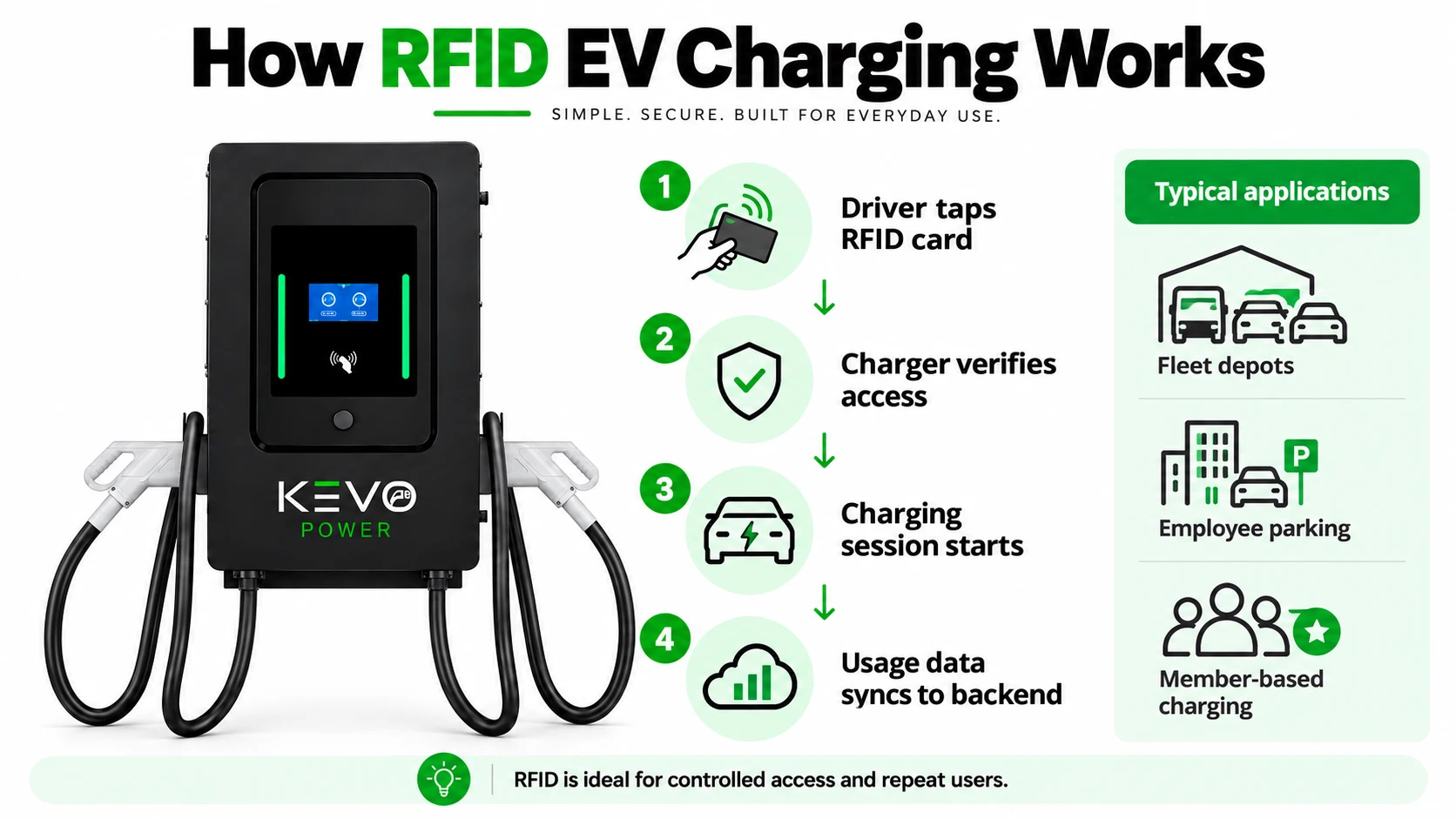
- Driver taps an enrolled RFID card or fob at the reader.
- The charger or backend validates the identifier and applicable access rights.
- Charging begins if authorization succeeds and the EV and charger are ready.
- Session and energy records are associated with an account for reporting or subsequent billing.
Where RFID Works Best
RFID is attractive in employee parking, managed fleets, residential or workplace charging, and networks with regular customers. It is quick to use, can enable account-level controls, and does not require the driver to complete a new online checkout each time.
RFID Limitations
RFID credentials may require provisioning, card distribution, account management, and replacement when lost. A visitor without a recognized credential may be unable to charge. An RFID charging card is also not automatically a bank payment card: an operator must still arrange billing or payment separately.
3. How QR Code EV Charging Payment Works
A QR code can direct a driver to a secure mobile payment page or app flow for a particular charging point. An operator might display a dynamic QR code on the charger screen or provide a code that resolves to an official checkout page. After the driver selects the connector and accepts the displayed tariff, a payment service verifies the payment method and the backend may authorize or remotely initiate charging.
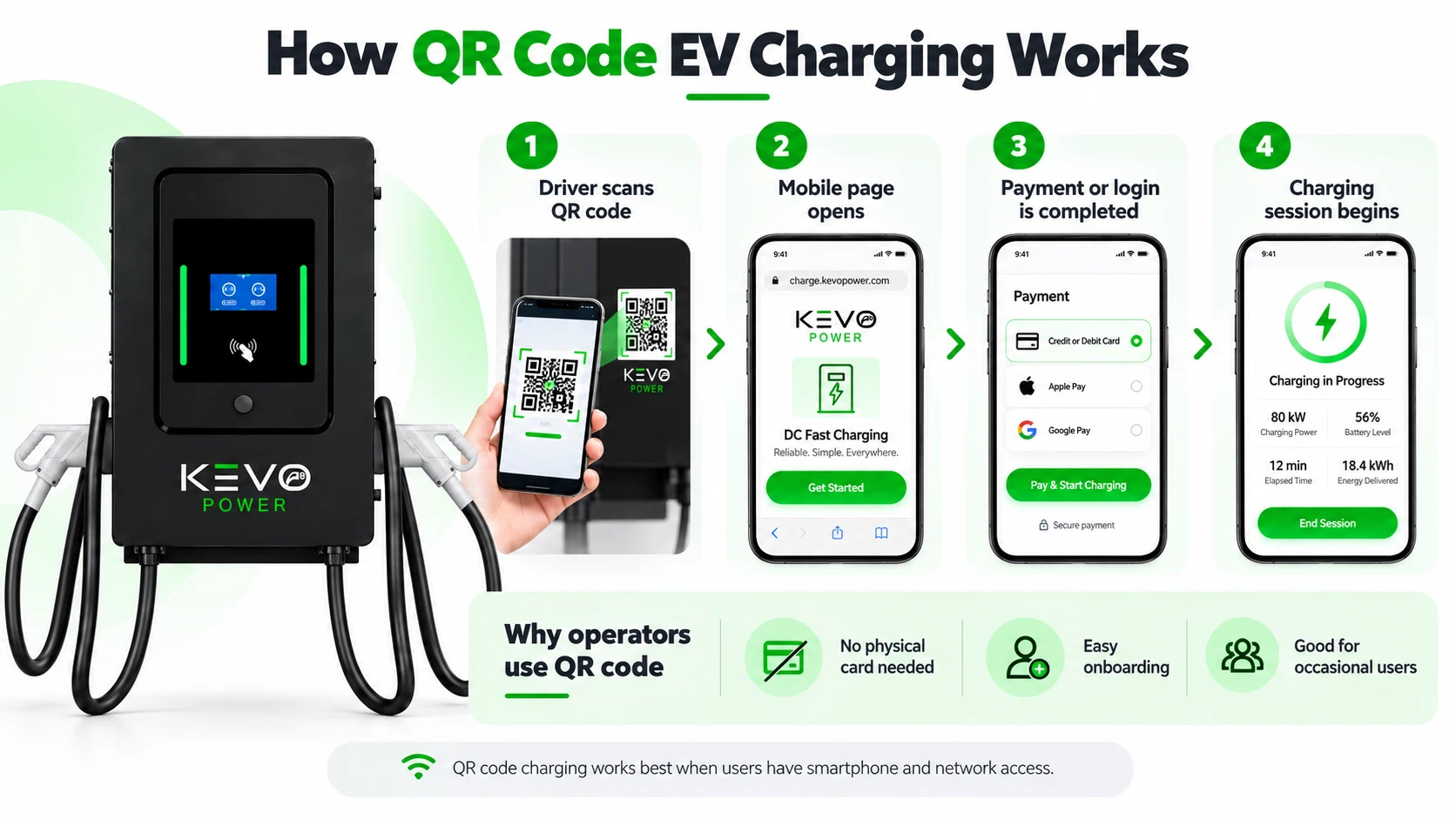
- Driver scans a verified charging-station QR code.
- A mobile web page or app identifies the station and displays the price and terms.
- The driver completes the required payment authorization or checkout.
- The payment/backend system links the approved purchase to the charging session.
- The operator produces a charging record and completes the final financial transaction according to its payment setup.
Benefits and Risks
QR workflows can reduce dependence on a dedicated payment terminal and can help visitors pay without obtaining an RFID card. But they depend on the phone, connectivity, checkout usability, and correct linkage between the code and the charging point. Static stickers can be replaced by fraudulent QR codes, so operators should use tamper-resistant placement, trusted domains, monitoring, and clear instructions. Dynamic codes can help associate a specific session with a checkout when implemented securely.
A QR code is only the entry point. The security and compliance of the actual payment flow depend on the website, payment service provider, authentication, and implementation—not on the QR graphic itself.
4. How Credit or Debit Card Payment Works
For ad hoc public charging, drivers may prefer familiar contactless bank cards or mobile wallets. A compatible payment terminal can authorize a card before charging, identify the approved transaction to the charging backend, and later capture or reconcile the final amount. Implementations vary: a terminal may be integrated into the charger or shared among multiple charging points where the project design and applicable rules allow.

- Driver selects a connector or charging point and taps/inserts a supported card or wallet.
- The terminal and payment service provider perform the necessary payment authorization.
- An approved reference is passed to the charging and management systems.
- The session starts subject to charger and vehicle readiness.
- After charging, the operator calculates the applicable charge and the payment provider completes the capture or adjustment process.
Bank card support can make a public station accessible to infrequent users without joining a network. The trade-offs are terminal procurement and maintenance, acquiring fees, connectivity, security obligations, and integration testing. Card-terminal failure can itself interrupt a charging session, so operators need operational monitoring and a backup customer support process.
5. EV Charging Payment Methods: RFID vs QR Code vs Credit Card

| Consideration | RFID credential | QR code checkout | Bank card terminal |
|---|---|---|---|
| Driver entry | Tap enrolled card/fob | Scan code and use phone | Tap/insert compatible payment card |
| Account requirement | Usually pre-enrolled | May support guest checkout | Often supports ad hoc use |
| Payment collection | Linked account / separate billing | Online payment service | Card acquiring/payment provider |
| Equipment | Reader + backend | Readable code + web/app flow | Compatible terminal + integration |
| Main friction | Card enrollment / network access | Phone, data and checkout steps | Terminal availability / acceptance |
| Good-fit sites | Workplace, fleets, members | Visitor-facing or supplemental checkout | Public fast charging / occasional drivers |
| Key risk | Unknown credentials | QR substitution / malicious link | Terminal faults and processing fees |
No single method is universally best. Most public charging projects benefit from matching payment access to the type of driver, applicable rules, and operating model rather than selecting a method solely because it is the least expensive to install.
6. EU AFIR Requirements: Why Charger Power Matters
For projects in the European Union, payment selection must consider Regulation (EU) 2023/1804, commonly known as AFIR. At publicly accessible charging points deployed from 13 April 2024, operators must offer ad hoc charging using a widely used payment instrument. For publicly accessible points rated at 50kW or more, the regulation specifies card-reader or contactless-card-reading solutions. For points below 50kW, qualifying secure internet-based payment such as QR-based checkout can be an option.
AFIR also provides a transition requirement from 1 January 2027 for publicly accessible charging points of 50kW or more along the TEN-T road network or in safe and secure parking areas, including earlier installations, to meet the relevant card acceptance requirements. Detailed obligations depend on site, commissioning date, power, and other conditions. Operators should consult the current consolidated text and local competent authorities before ordering hardware.
Importantly, RFID access, an operator app, or QR-only checkout should not be assumed to replace mandated ad hoc bank-card acceptance for qualifying high-power public charging points. AFIR also distinguishes genuine ad hoc charging from an arrangement that requires a broader ongoing service contract.
7. OCPP, Backend Software and Payment Integration
A reliable payment experience requires several systems to work together: the charger, its CSMS, customer-facing interface, payment service provider, and sometimes a roaming or billing platform. OCPP provides standardized charger-to-backend communication but is not, by itself, a payment gateway.
For example, an RFID identifier can be sent for authorization through supported OCPP functions. In QR-based charging, a web checkout can lead the CSMS to initiate charging remotely. For card terminals, a payment authorization reference can be associated with a charging session. The exact message flow differs by OCPP version and system architecture.
OCPP 2.1 adds functionality for ad hoc payment and secure dynamic QR-code use cases, but a product advertising support for an OCPP version does not necessarily implement every optional payment-related feature. Buyers should validate end-to-end integration rather than assuming that a protocol label guarantees a complete payment solution.
8. Technical Case Studies: Selecting the Right Setup
Case A: Private Logistics Depot with 12 Fleet Vehicles
An operator manages a private depot where only registered company drivers charge overnight. RFID may be a practical primary authorization method: fleet cards identify drivers, charging records attach to vehicles or cost centers, and billing is handled internally. Adding public bank-card acceptance might be unnecessary if the site is not publicly accessible and no applicable obligation requires it.
Case B: Retail Parking with Short-Term Visitors
A shopping center serves both regular members and occasional visitors. RFID can simplify repeat-user access, while a verified mobile checkout can assist compatible guest workflows. The operator should test the complete experience on different phones and clearly explain prices, idle fees, refunds, and receipts.
Case C: Public 180kW DC Fast-Charging Site in the EU
At a new publicly accessible 180kW fast-charging site in the EU, a properly integrated contactless card acceptance solution is a critical consideration under AFIR. RFID and QR access can complement the card terminal, but they should not be treated as substitutes for mandatory card acceptance. The operator must confirm compliance, device placement, terminal connectivity, payment availability, and failed-session recovery.
These are illustrative design scenarios, not claims about a specific KEVO charger installation or guaranteed legal outcomes.
9. Payment Security, Fraud Prevention and Reliability
For charging operators, payment reliability matters as much as payment choice. A failed card reader, mismatched charging session, outdated tariff, or malicious QR sticker can prevent charging or cause customer disputes.
- Use a reputable payment service provider, appropriate encryption, and applicable payment industry controls.
- Do not expose or store sensitive cardholder data in ordinary charger logs or identifiers.
- Verify that station IDs, connector selection, payment references and invoices remain aligned.
- Regularly inspect any physical QR labels and provide a recognizable official website domain.
- Monitor payment approval rates, session-start failures, refunds and terminal connectivity.
- Provide clear customer support and receipt mechanisms for disputed or unsuccessful sessions.
10. What CPOs and Distributors Should Ask Before Purchasing
- Does the actual charger model include an RFID reader? Which cards, credential types and backend authorization modes are supported?
- Is QR-code payment implemented by the charger firmware, third-party app, web checkout or CSMS? Can it securely identify a particular connector?
- Does the equipment support an integrated or external EMV/contactless payment terminal? Which exact terminal models have been tested?
- Which OCPP version and authorization/remote-start functions are implemented and tested with the target CSMS?
- How are tariffs, session records, receipts, refunds, preauthorization and final payment capture handled?
- Can the charger and payment system recover gracefully after a network interruption or terminal failure?
- What local accessibility, consumer information, cybersecurity and public-payment rules apply?
- Who owns the end-to-end integration and support responsibilities: charger manufacturer, CPO software provider, payment integrator or acquirer?
11. KEVO Power: Choosing Charging Hardware for Your Payment Strategy
KEVO Power supplies AC and DC EV charging equipment for residential, workplace, commercial and public charging projects. Payment and authorization requirements should be part of the initial hardware and backend selection process, not added only after installation.
For a private fleet or managed parking site, the priority may be account-based access and operational reporting. For a retail or public DC charging station, visitors may require easy ad hoc checkout and, where applicable, a compliant card acceptance solution. The appropriate setup depends on the selected model, project location, CSMS, payment provider and local requirements.
Before purchasing, ask the KEVO Power team to confirm the exact model’s RFID hardware, supported OCPP functions, compatibility with any proposed QR checkout or payment terminal, and the scope of completed integration testing. Do not assume that every KEVO charger supports every method without verification.
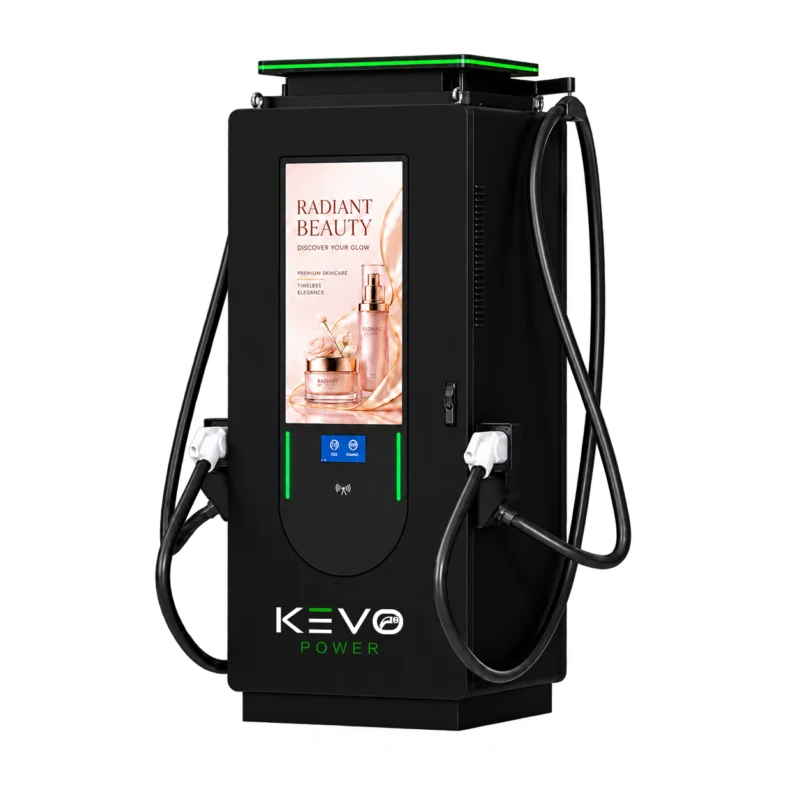
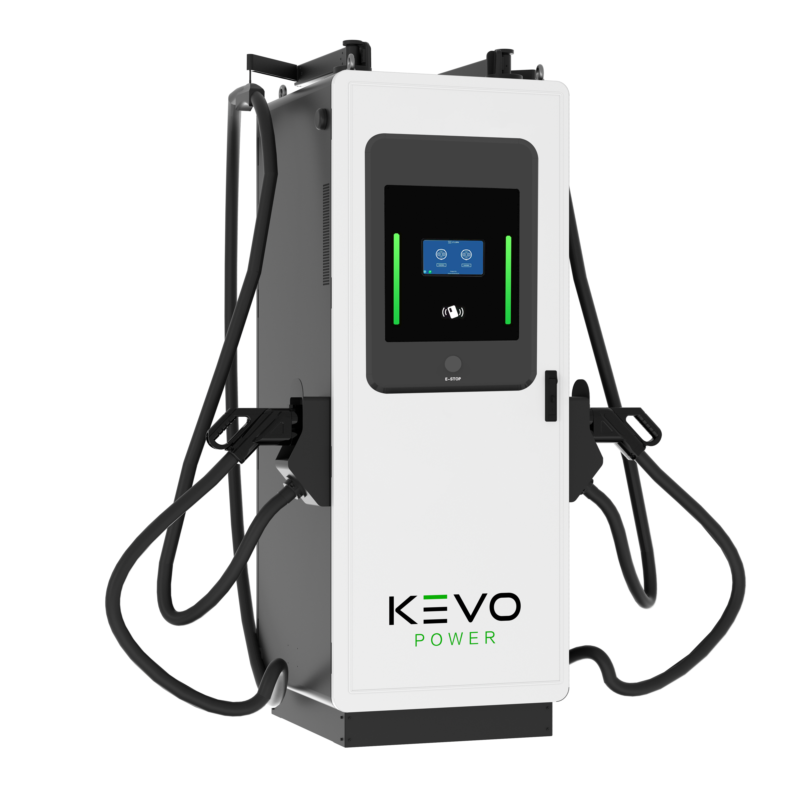
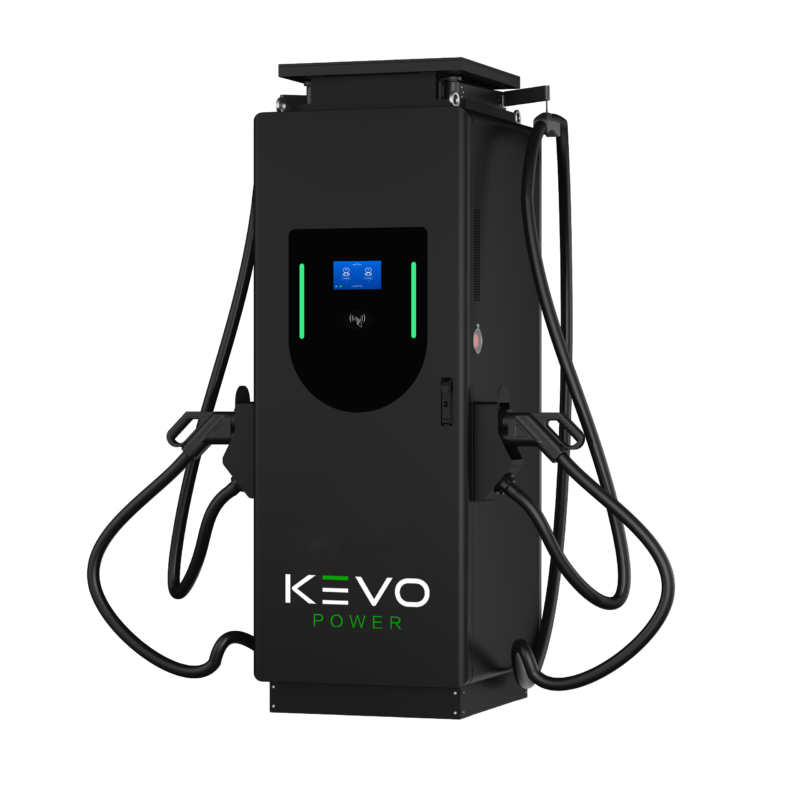
Planning a commercial charging project? Review the KEVO DC Series III dual-gun DC fast charger, browse our EV charger datasheets, or contact KEVO Power to confirm the exact RFID hardware, OCPP functions, QR checkout compatibility, payment-terminal integration, and testing scope required for your project.
12. Frequently Asked Questions
Q1. Is RFID itself a payment method?
Usually it is an authorization credential linked to an account. The actual charge may be billed later or collected using a separate payment arrangement.
Q2. Can drivers use a QR code without downloading an app?
Yes, a secure mobile-web checkout can support app-free guest payment, depending on the operator’s implementation.
Q3. Does every EV charger accept bank cards?
No. Bank card acceptance requires appropriate payment hardware or supported payment integration and is not automatic with OCPP connectivity.
Q4. Which method is fastest for regular fleet drivers?
An enrolled RFID card or fob is often convenient for repeated access, although actual session-start performance depends on the backend and charger.
Q5. Is QR-only payment enough at a new 150kW public charger in the EU?
Generally no under the AFIR ad hoc payment requirements applicable to public points of 50kW or more deployed since 13 April 2024; a qualifying card/contactless acceptance solution is needed.
Q6. Does OCPP handle card settlement?
No. OCPP supports charger/backend communication. Acquiring, payment processing, capture and settlement normally involve external services.
Q7. Can RFID and bank card payment coexist?
Yes. An operator may offer several authorization and payment paths, provided the equipment, backend and payment systems are integrated correctly.
Q8. What is an ad hoc EV charging payment?
It is a way to purchase charging without needing a broader pre-existing contract or subscription with the charging operator or mobility service provider.
Q9. What happens if a QR code is replaced by a scam sticker?
Drivers could be redirected to an illegitimate site. Operators should inspect codes, use official domains and secure checkout, and give customers clear verification cues.
Q10. How should a CPO choose among the three?
Start with driver types, site access, local payment rules, total integration and maintenance costs, and actual end-to-end testing.
Conclusion
RFID, QR code and bank card payment each solve different parts of the EV charging access problem. RFID is well suited to enrolled users and fleet accounts; secure QR checkout can provide flexible phone-based guest access; and card terminals can deliver familiar ad hoc payment for public drivers and help meet relevant regulatory obligations.
The best commercial charging strategy is not simply to choose one payment icon. It is to build a complete, tested experience that joins the charger, authorization system, tariff display, payment service, charging session and customer support process. KEVO Power can help project buyers evaluate charging hardware requirements while the relevant software and payment specialists confirm the full solution.
Technical References
European Union — Regulation (EU) 2023/1804, Article 5: Official text
European Commission — AFIR Questions and Answers: European Commission guidance
Open Charge Alliance — OCPP 2.1 payment features: OCA FAQ
National Charging Experience Consortium — Best Practices for Payment Systems at Public Electric Vehicle Charging Stations (2024): NREL report
For buyers comparing EV charging payment methods, the final decision should be based on driver type, site access, local payment rules, lifecycle cost, and verified end-to-end integration.
For commercial operators, EV charging payment methods should be selected as part of the complete charger and CSMS design. These EV charging payment methods can be combined to support fleet users and ad hoc drivers.
When comparing EV charging payment methods, operators should validate the full user journey from authorization to receipt. Clear EV charging payment methods also reduce support issues for fleet and public charging users.