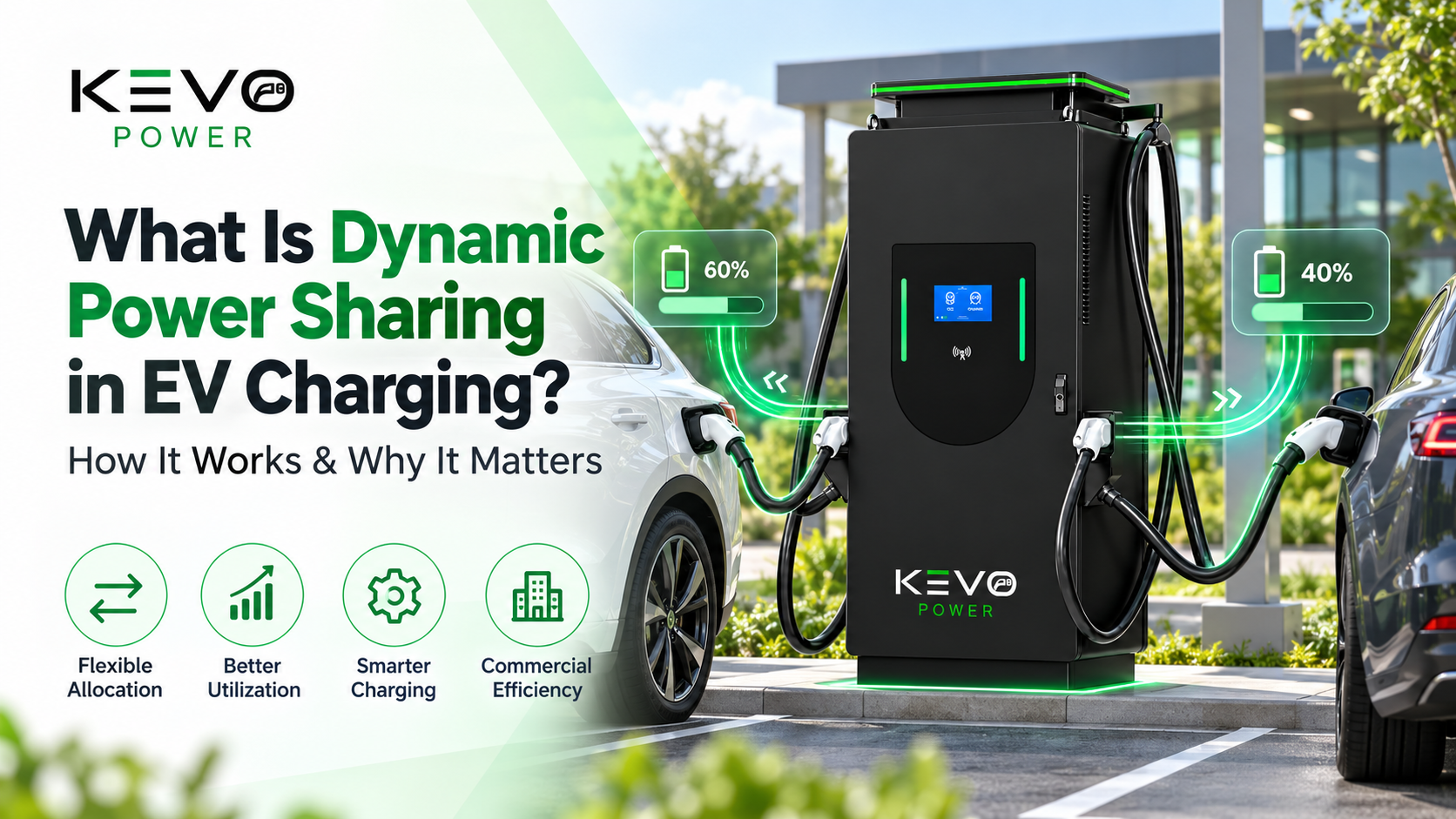
As electric vehicle adoption grows, commercial charging sites need more than high-power equipment. They also need to use available electrical capacity efficiently while delivering a reliable charging experience.
Consider a dual-gun 120 kW DC fast charger serving two EVs. If one vehicle requests only 30 kW while the other can accept 90 kW, an equal 60/60 split may leave useful capacity unused. Dynamic power sharing, also called dynamic power allocation, allows a suitably designed charger to adjust output between connectors according to real-time demand, available capacity, and operating limits.
This guide explains how dynamic power sharing works, how it differs from static allocation and site-level load balancing, where it matters, and what commercial buyers should verify before choosing equipment.
What Is Dynamic Power Sharing in EV Charging?
Dynamic power sharing is a control approach that distributes and adjusts available charging power among multiple outputs as charging conditions change. Instead of assigning a permanently fixed limit to each connector, compatible hardware and firmware can redistribute available capacity when one vehicle needs less power and another can accept more.
For example, a 120 kW dual-gun DC charger may provide up to 120 kW to one vehicle when only one connector is active, provided the charger architecture, connector limit, vehicle, temperature, and site conditions all support that output. When two EVs charge simultaneously, the same total capacity can be shared between them.
The key principle
Dynamic power sharing does not simply divide power equally. It responds to actual demand and system constraints, including:
- Total available charger output
- Number of active connectors
- Maximum power and current per connector
- Vehicle charging requests and battery conditions
- Power-module configuration and allocation increments
- Cable and connector ratings
- Thermal derating and safety limits
- Priority rules and control strategies
How Does Dynamic Power Sharing Work?
1. Detect connected vehicles
When an EV connects, the DC charger establishes communication, identifies the active connector, and receives relevant voltage and current requests from the vehicle.
2. Determine available capacity
The charging controller calculates usable capacity from the charger’s rated output and current operating limits. Available output may be lower because of temperature, electrical limits, or external power-management instructions.
3. Allocate power between connectors
The controller applies the charger’s allocation logic. Some designs use shared power-module groups that can be assigned to different outputs; others use different conversion architectures. The exact behavior depends on the equipment design.
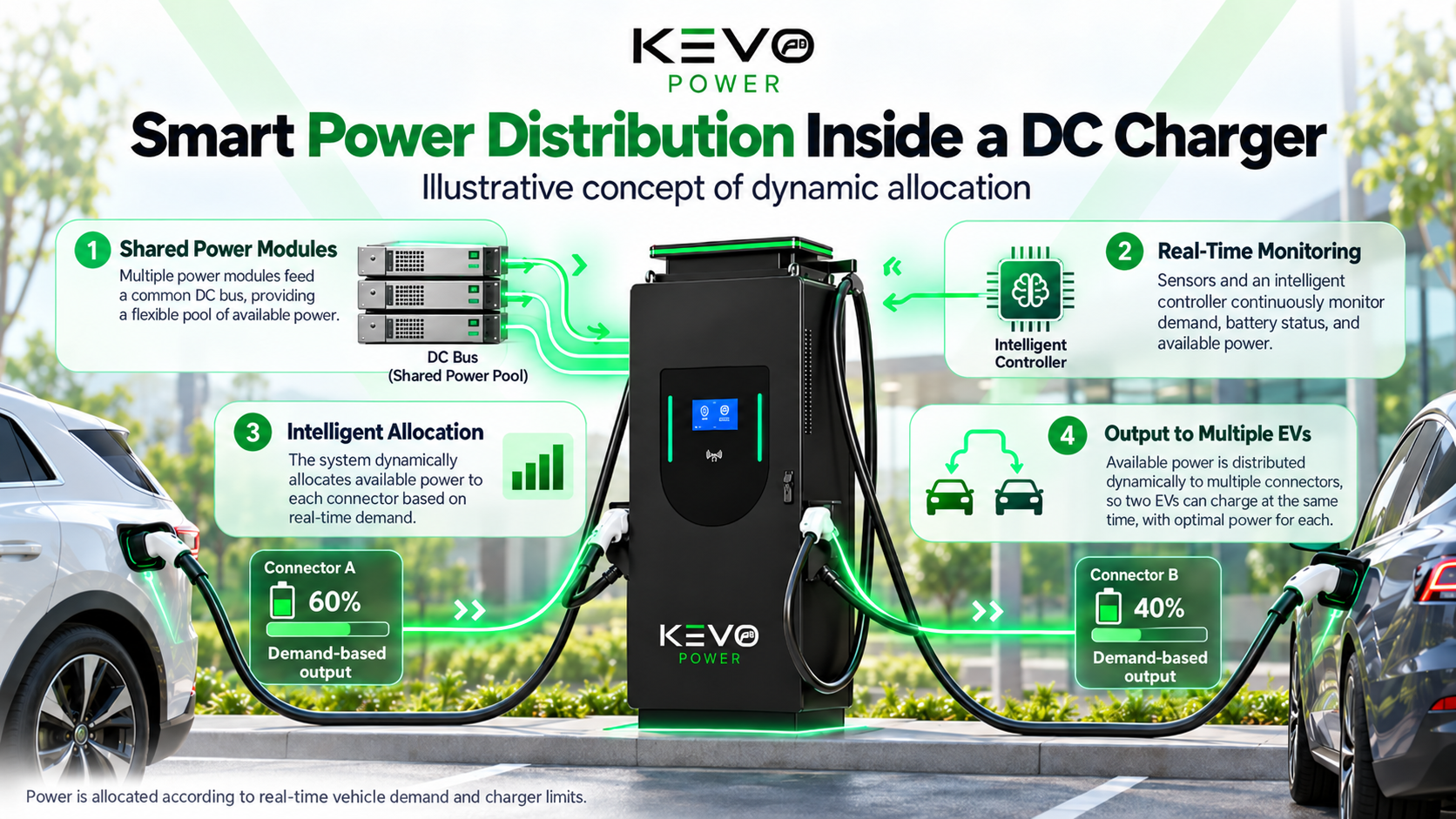
4. Monitor changing demand
Vehicle demand changes throughout a session. As state of charge increases, the battery management system often requests less current. The charger continuously monitors those changes.
5. Redistribute available power
If one connector needs less power, the controller may make more capacity available to another active connector, while remaining within charger, cable, connector, vehicle, and safety limits.

Dynamic Power Sharing Example for a 120 kW Dual-Gun Charger
The following simplified scenarios assume a hypothetical charger that can flexibly allocate its full 120 kW between two connectors, with each connector able to deliver the required output and no additional restrictions. These figures are illustrative and are not confirmed specifications for a particular KEVO Power model.
Scenario A: one vehicle is charging
- Vehicle A: 120 kW
- Vehicle B: 0 kW
- Total output: 120 kW
Scenario B: two vehicles have similar demand
- Vehicle A: 60 kW
- Vehicle B: 60 kW
- Total output: 120 kW
Scenario C: two vehicles have different demand
- Vehicle A: 30 kW
- Vehicle B: 90 kW
- Total output: 120 kW
Scenario D: one vehicle begins tapering
- Vehicle A: 25 kW
- Vehicle B: 95 kW
- Total output: 120 kW
The exact allocation may change in module-sized increments. A charger also cannot force an EV battery to accept more power than its battery management system requests.
Static vs. Dynamic Power Sharing
Not all multi-connector chargers distribute power in the same way. A static system applies predetermined limits, while a dynamic system adjusts output as demand changes.
| Feature | Static Power Allocation | Dynamic Power Sharing |
|---|---|---|
| Allocation method | Predetermined limits | Adjustable according to conditions |
| Response to demand | Limited flexibility | Responds to changing demand |
| Unused capacity | May remain unavailable | Can potentially be redistributed |
| Multi-vehicle operation | Fixed allocation rules | More flexible distribution |
| Control requirements | Generally simpler | Suitable hardware and software required |
| Best fit | Basic multi-output charging | Commercial sites with variable demand |

Actual performance depends on implementation. Buyers should evaluate operating modes, allocation granularity, per-connector limits, and tested simultaneous-charging performance.
Benefits of Dynamic Power Sharing
Better use of available charger power
EV demand varies, even when the charger has a fixed maximum rating. Dynamic allocation can redirect otherwise unused capacity to a vehicle that can accept it.
More flexible multi-vehicle charging
Public sites, retail parking and fleet depots serve vehicles with different limits. Compatible equipment can adapt its output rather than always applying an equal split.
Potentially shorter sessions
A vehicle capable of accepting 90 kW may benefit when the other connector needs only 30 kW. Faster charging is not guaranteed because charging curves, state of charge, battery temperature and other constraints still apply.
Improved driver experience
Flexible allocation can help a station serve different vehicles more effectively and may reduce avoidable waiting when the hardware, vehicle mix and site conditions are suitable.
More adaptable infrastructure planning
Shared-power architecture can be an alternative to providing independent peak capacity for every connector. Financial results depend on equipment, installation, utilization, tariffs and site requirements; dynamic sharing does not automatically reduce energy consumption or cost.
Dynamic Power Sharing vs. Dynamic Load Balancing
These terms address different layers of power management.
Dynamic power sharing
This usually describes how a shared pool of DC output is distributed among connectors within one charger or shared charging system.
Dynamic load balancing
This typically manages several chargers or building loads within a site-wide electrical limit. A site energy-management system may consider grid capacity, building consumption, active sessions, priorities, solar generation and battery storage.
How they work together
At a site with several dual-gun chargers, site-level management can set each charger’s permitted power while each charger allocates its permitted output between connected EVs. Support for one function does not guarantee support for the other.
How OCPP Supports Smart Power Management
OCPP enables communication between EV charging stations and charging station management systems. A CSMS can apply charging profiles to manage site demand where those functions are implemented.
OCPP is not the same as dynamic power sharing. OCPP provides standardized communication mechanisms, while internal power redistribution depends on charger hardware, firmware and control architecture. Buyers should verify both the required OCPP functions and the charger’s actual allocation capabilities.
Where Dynamic Power Sharing Matters
Public DC fast charging stations
Public stations serve EVs with varied charging limits, making responsive allocation useful when simultaneous demand changes.
Shopping malls and retail parking
Visitors have different dwell times and energy needs. Shared-power systems can adjust output while operators balance utilization and user experience.
Highway service areas
Demand fluctuates and drivers arrive with different states of charge. Flexible allocation can help use available capacity efficiently.
Commercial fleet charging
Fleet depots often charge within defined operating windows. Charger-level sharing can work alongside schedules and site-level energy management.
Commercial parking facilities
Sites with constrained electrical infrastructure may benefit from coordinated power management across vehicles and chargers.

How to Choose a DC Fast Charger with Dynamic Power Sharing
- Confirm total rated output. Ask for the maximum combined DC power under normal and derated conditions.
- Check the per-connector limit. Do not assume every connector can deliver the charger’s full advertised rating.
- Verify allocation modes. Ask whether the charger supports equal, demand-based, priority-based and automatic reallocation.
- Ask about allocation granularity. Many designs move power in discrete module increments.
- Confirm simultaneous charging. Two cables alone do not prove that both can charge at once or share power dynamically.
- Review connector and vehicle compatibility. Check standards, voltage range and current ratings.
- Verify OCPP and backend integration. Test the charger with the intended CSMS when advanced management is required.
- Evaluate thermal management and serviceability. Review cooling, protection, maintenance and derating behavior.
Commercial EV Charging Solutions from KEVO Power
KEVO Power provides AC and DC EV charging solutions for public charging stations, parking facilities, shopping centers, fleets and distribution projects.
For dual-gun DC projects, evaluate not only the total rated output but also how power is distributed during simultaneous charging. For configurations requiring dynamic power sharing, confirm the selected model’s allocation logic, connector limits, power-module architecture and backend requirements with the KEVO Power technical team.
Looking for a DC fast charging solution?
Contact KEVO Power to discuss site capacity, vehicle mix, connector standards, OCPP integration and the appropriate charging configuration for your project.
Frequently Asked Questions
What is dynamic power sharing in EV charging?
It adjusts available charging power among multiple outputs according to vehicle demand, system capacity and operating limits.
How does it work in a dual-gun DC charger?
A compatible charger monitors both vehicles and allocates output according to demand, hardware capability and safety limits.
Can a 120 kW dual-gun charger deliver 120 kW to one vehicle?
It depends on the design. Some chargers support full power on one connector, while others have lower per-connector limits. The vehicle must also be able to accept that power.
Is power sharing the same as load balancing?
No. Power sharing commonly distributes output within a charger; load balancing generally manages demand across a site or group of chargers.
Does dynamic power sharing reduce charging time?
Sometimes, when a vehicle can accept additional available power. Results depend on its charging curve, battery conditions and concurrent demand.
Does OCPP automatically enable dynamic power sharing?
No. OCPP supports communication, but internal redistribution requires compatible hardware, firmware and control logic.
Does every dual-gun DC charger support it?
No. Some use fixed allocation rules. Buyers should verify the operating modes in the technical documentation.
What should buyers ask manufacturers?
Ask about combined and per-connector power, simultaneous operation, module increments, control logic, OCPP integration, thermal constraints and tested operating modes.
Conclusion
Dynamic power sharing helps compatible chargers use available capacity more intelligently by responding to changing vehicle demand instead of relying only on a fixed split. For commercial operators, that flexibility can improve utilization and multi-vehicle operation, but the results depend on real charger capabilities, vehicle characteristics and site conditions.
Before procurement, verify rated output, connector limits, simultaneous charging, allocation logic and management compatibility. Talk with KEVO Power about the operating requirements for your EV charging project.