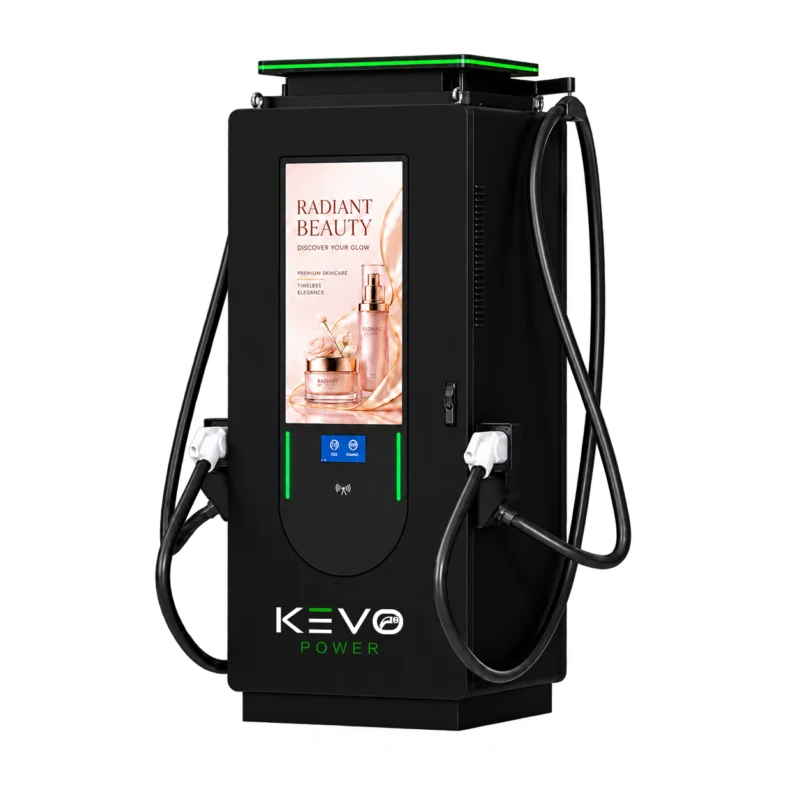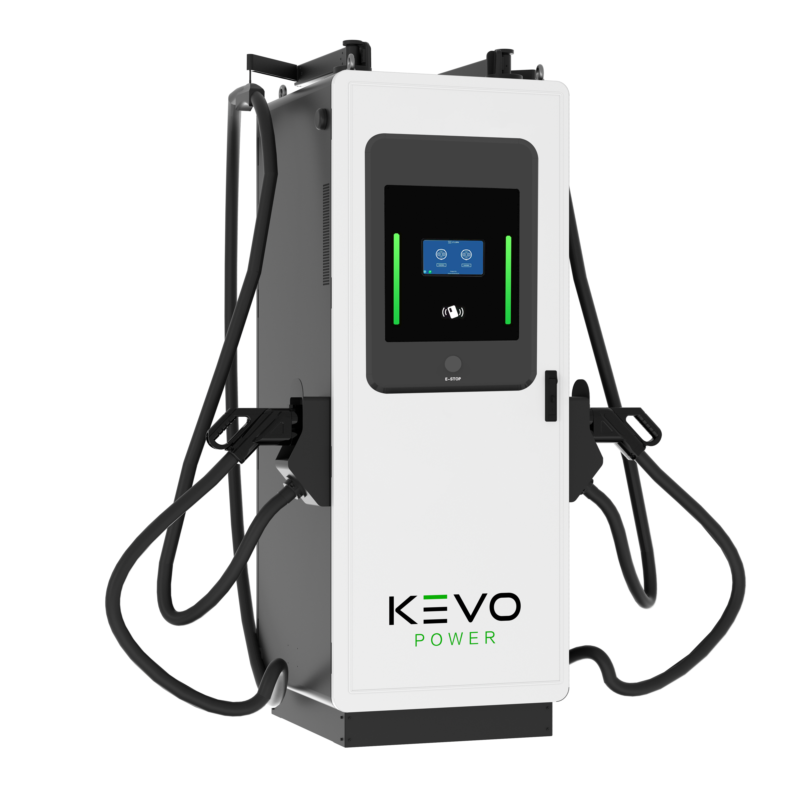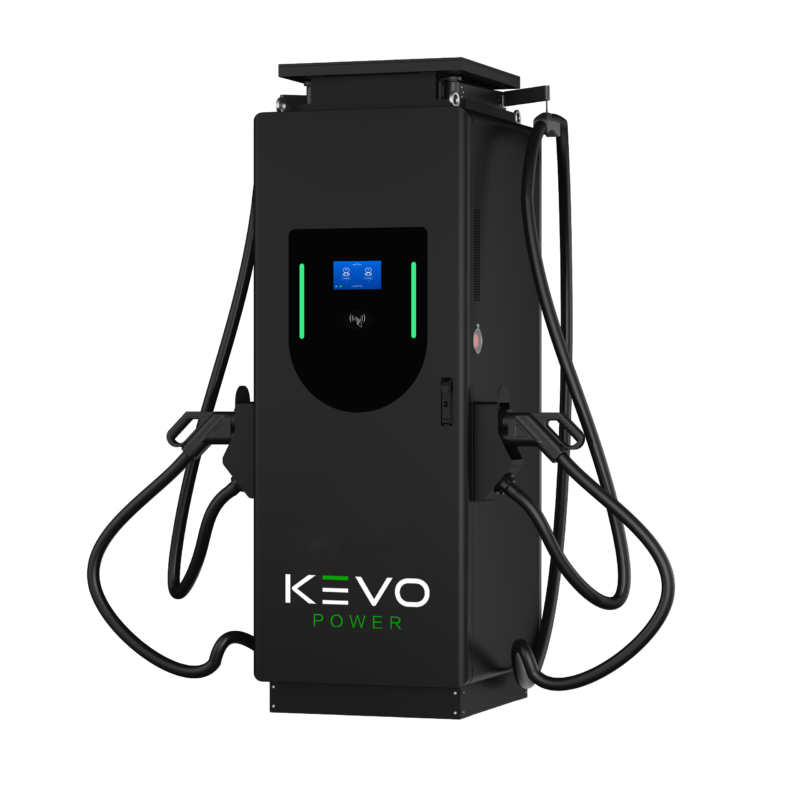
EV chargers with advertising screens can support two commercial functions at one location: reliable vehicle charging and digital communication. For charge point operators, retailers, hotels, and commercial property owners, a visible screen may create additional revenue opportunities when the site, audience, content workflow, and commercial agreements are right.
Advertising income is not guaranteed. Results depend on location, traffic, visibility, contracts, uptime, advertiser demand, and operating costs.
What are EV chargers with advertising screens?
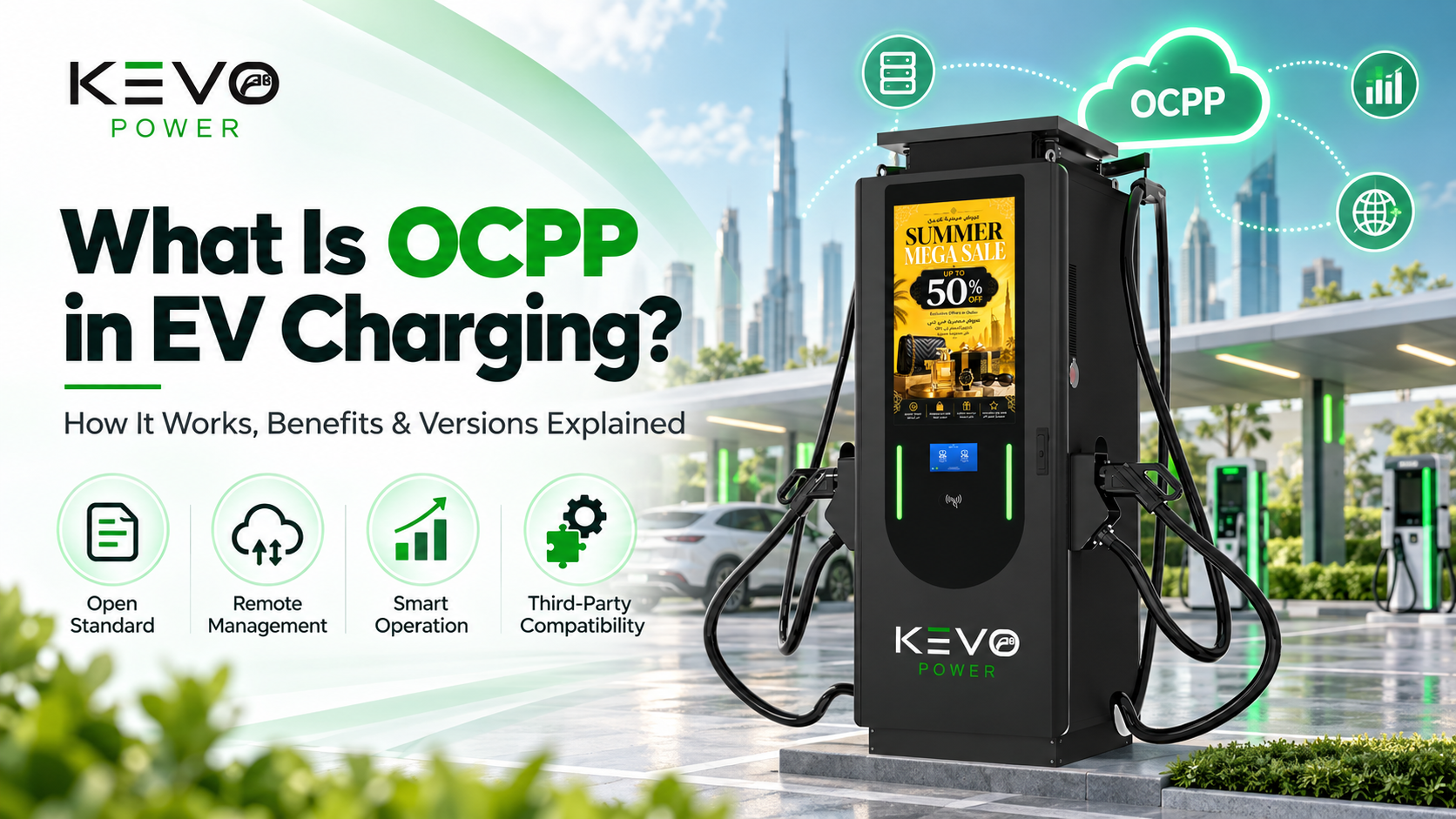
An advertising screens EV charger combines DC charging equipment with a dedicated digital display. Operators can show charging instructions, public-service messages, retailer promotions, brand campaigns, local events, or their own offers. Digital out-of-home (DOOH) media is delivered through screens in public and commercial environments. An EV charging site can be useful media inventory when the screen has strong sightlines and a definable audience.
Advertising screens need a clear audience proposition and measurable workflow. The display alone does not create media value. Brightness, viewing angle, dwell time, audience quality, placement, content control, and proof of playback all matter. Buyers should evaluate the entire station and software workflow, not only the screen size.
Two potential revenue streams from one charger
1. Charging service revenue
A CPO may earn from delivered energy and service charges where permitted. The contribution depends on utilization, electricity costs, tariffs, transaction fees, maintenance, network expenses, and local market rules. Advertising should be modeled as a separate contribution rather than a substitute for healthy charging economics.
2. Advertising and promotional revenue
Operators may sell local advertising slots, venue sponsorships, co-marketing packages, time-based campaigns, or managed DOOH inventory. A shopping mall could promote tenants and seasonal events; a highway service area could promote restaurants, hotels, and travel services. Some benefits are indirect, such as better tenant visibility or useful customer messaging, and should not be counted as cash advertising revenue unless they are measured and attributed.
Seven revenue opportunities
- Local advertising slots: sell time to nearby retailers, restaurants, hotels, and service businesses.
- Venue sponsorship: let a host or brand sponsor one or more charging locations.
- Network media packages: bundle screens across several sites for coordinated campaigns.
- Retail self-promotion: promote tenants, seasonal offers, events, or loyalty programs.
- Managed DOOH: work with an approved media or ad-tech partner and agree revenue share.
- Sponsored charging information: pair useful wayfinding or charging guidance with clearly labeled sponsorship.
- Cross-promotion: connect the charging site with destination services, memberships, or fleet programs.
A sensible pilot starts with house advertisements and a small number of local sponsors. Confirm display software, connectivity, content rights, approval workflows, and local advertising rules before scaling.
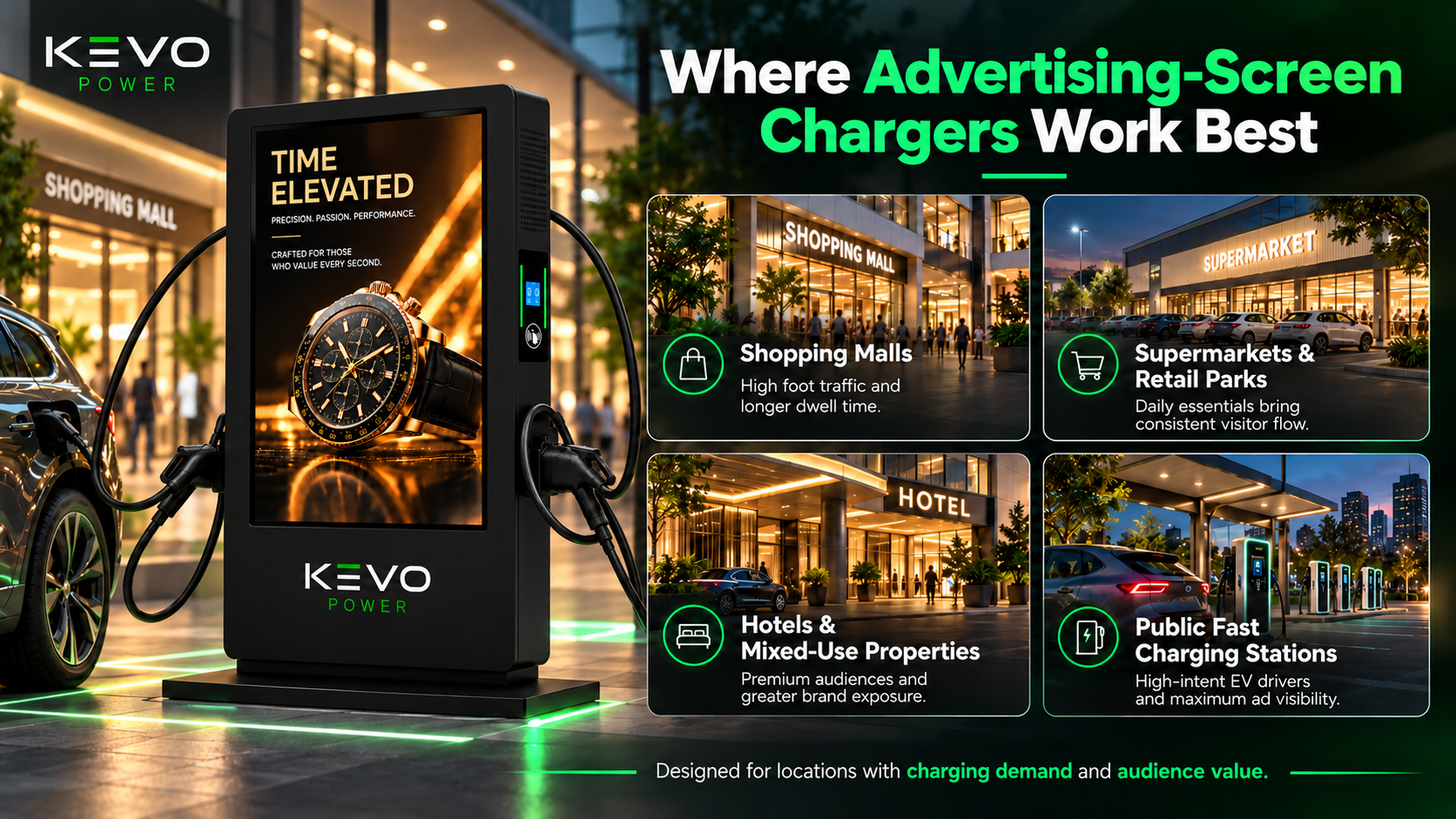
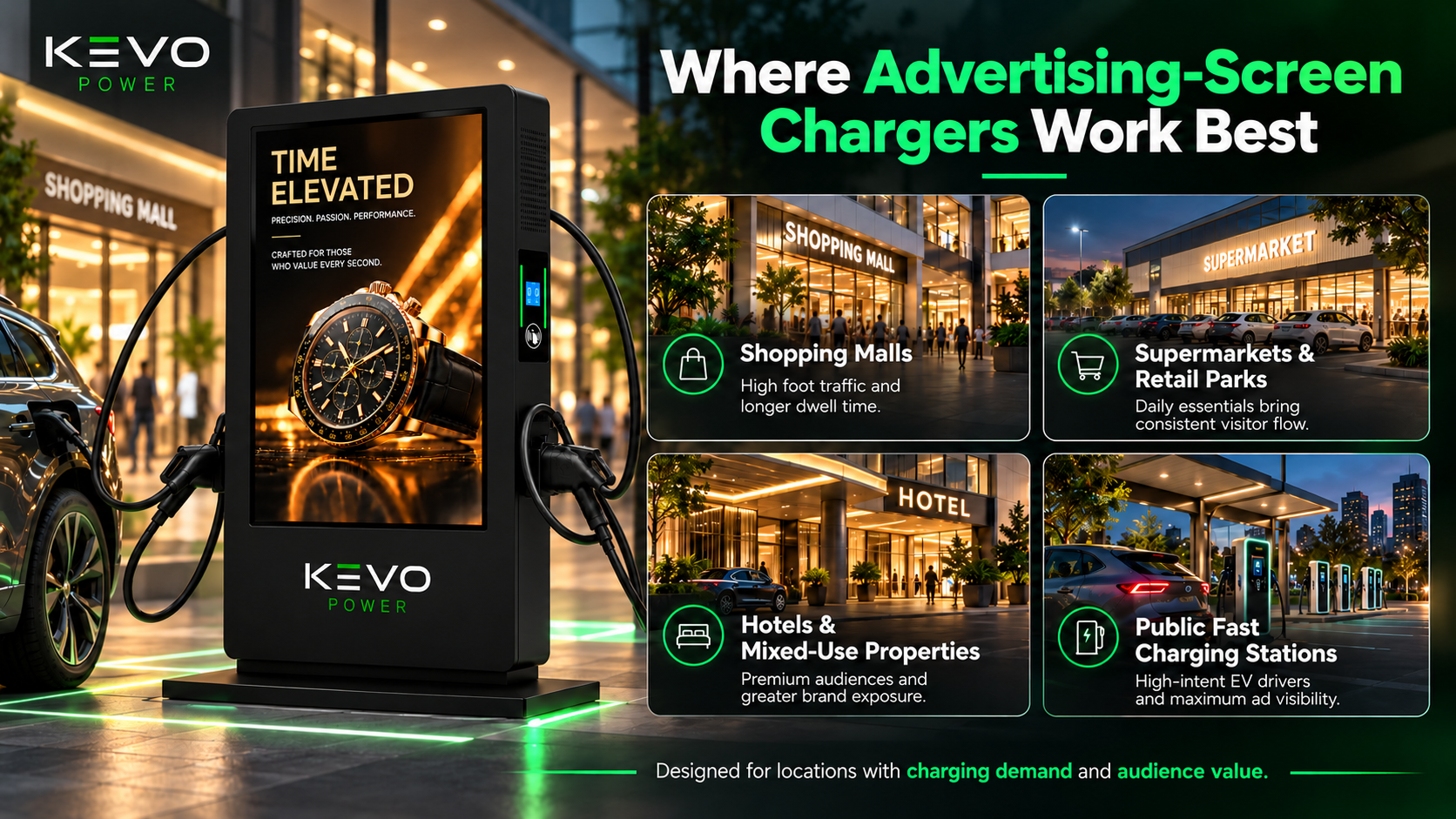
Where advertising screens EV chargers can perform best
- Shopping malls and supermarkets: tenant promotions, seasonal offers, and loyalty messages can match longer dwell times.
- Highway service areas and fuel stations: restaurants, convenience stores, accommodation, and vehicle services may value local exposure.
- Hotels and mixed-use properties: screens can support guest information, destination promotions, and venue sponsorship.
- Public charging hubs: multiple networked screens can support coordinated campaigns when operators can report uptime and playback credibly.
How to model advertising revenue transparently
Use conservative assumptions instead of a headline promise. For an illustrative example, imagine 10 stations, two paid slots per screen, a list price of $120 per slot per month, 60% paid occupancy, and a 20% media-sales commission. Gross monthly billings would be 10 × 2 × $120 × 60% = $1,440. After commission, monthly media receipts would be $1,152, or $13,824 annually before other expenses.
This is not a KEVO revenue guarantee, market-rate quote, or city forecast. Deduct electricity, connectivity, content creation, software licenses, player hardware, maintenance, insurance, venue revenue share, taxes, sales labor, and cancellations. Model conservative, base, and optimistic occupancy cases and compare station economics with and without advertising.
How to measure performance credibly
Screen-on time, scheduled impressions, playback records, opportunities to see, and human ad impressions are different metrics. A practical reporting stack can include proof-of-play logs, screen uptime, creative IDs, campaign schedules, location-level performance, and clearly defined audience estimates. A QR code or promotional URL can provide an engagement signal, but it does not represent every viewer or prove causality. Privacy obligations must be considered when using cameras, sensors, device data, or analytics.
Advertising CMS, OCPP, and remote management
An EV charger normally connects to a charging station management system for sessions, status, monitoring, and supported remote operations. OCPP is the open protocol between the station and that backend. An advertising content-management system has a different job: media assets, playlists, scheduling, publishing, remote updates, and playback reporting.
OCPP 2.0.1 includes display and messaging capabilities, but that is not the same as a complete third-party advertising platform. Ask suppliers to document the media player, CMS, supported formats, offline playback, connectivity, remote-update process, scheduling, and reporting. A typical architecture is EV charger ⇄ OCPP ⇄ charging CSMS; integrated screen ⇄ media CMS ⇄ advertising operator.
Technical checklist before buying
- Confirm screen size, orientation, brightness, viewing angle, resolution, protection, and operating temperature.
- Verify image and video formats, playlists, multilingual campaigns, remote updates, and offline playback.
- Check Ethernet, cellular or Wi-Fi options, bandwidth expectations, and recovery after interruptions.
- Ensure advertising playback cannot interfere with charging controls, safety functions, or essential user information.
- Review monitoring, access roles, software updates, media approval, cybersecurity, and privacy practices.
- Confirm service access, spare parts, cleaning, vandalism resistance, display life, and support arrangements.
- Document advertising rights, host revenue share, prohibited content, approvals, sales ownership, and reporting responsibility.
KEVO Power advertising-screen DC solutions
KEVO Power lists commercial DC fast-charging equipment with selected advertising-screen configurations. The Ultra DC Series VI is listed with 60 kW, 80 kW, 120 kW, 160 kW, 180 kW, and 240 kW options plus a 32-inch advertising screen, OCPP 1.6J / 2.0.1, and 4G, Ethernet, and Wi-Fi connectivity. Selected 55-inch configurations are also available in the current range.
Before purchasing, confirm the exact model, screen specification, CMS workflow, third-party platform requirements, site installation conditions, and commercial software arrangements. See the Open Charge Alliance OCPP protocols for the charging-backend layer. A screen specification alone does not imply a fixed advertising yield or universal media-network compatibility. Discuss your project with KEVO Power or review the product catalog and datasheets.
Frequently asked questions
Can an EV charging station earn money from advertising?
Potentially. Paid campaigns, sponsorships, and venue promotions can add commercial value, but results depend on advertiser demand, visibility, contracts, uptime, and costs.
Does an advertising screen automatically increase charging revenue?
No. Charging income and advertising income should be modeled separately.
How much can an advertising-screen charger earn?
There is no universal figure. Use local assumptions for rates, occupancy, commissions, venue share, and operating costs, then validate them in a pilot.
Can ads be updated remotely?
That depends on the media CMS and hardware/software configuration. Ask the supplier to demonstrate publishing, scheduling, recovery, and reporting.
Does OCPP control advertising?
OCPP primarily supports charger-to-backend communication. Dedicated advertising CMS functions should be verified separately.
Conclusion
EV chargers with advertising screens can connect reliable charging with digital communication at the point of use. The strongest opportunity is the combination of a good site, a clear audience proposition, a practical media-sales model, dependable playback, and transparent reporting. A disciplined pilot and conservative financial model are more valuable than promised advertising returns.
Contact KEVO Power to evaluate your application and confirm available technical options.