OCPP EV charging connects charging stations with management platforms so operators can authorize drivers, monitor charger availability, record energy use, identify faults, and manage equipment across locations. For commercial networks, that backend connection can be as important as the charger's power rating.
Because OCPP is an open protocol, it can support greater flexibility between charging hardware and management software. Buyers planning a new site or expanding an existing network should understand the supported version, enabled functions, security configuration, and testing scope before selecting equipment.
What Is OCPP in EV Charging
OCPP stands for Open Charge Point Protocol. Developed and maintained by the Open Charge Alliance (OCA), it is an open communication protocol between an EV charging station and a Charging Station Management System (CSMS), often called an EV charger management platform or charging backend.
Think of OCPP as a common language between the charger and the management software. Instead of requiring every charger manufacturer and software provider to invent a private communication method, OCPP defines standardized messages for many charging operations.
This does not mean every OCPP charger will work immediately with every backend. Both sides must implement compatible protocol versions, the relevant features, security settings, and any necessary integration requirements. Interoperability should be tested for the actual project.
How OCPP EV Charging Works
In a typical OCPP deployment, an EV charger communicates over a network connection—such as Ethernet, Wi-Fi, or cellular data—with its CSMS. OCPP messages travel between these two systems; the separate charger-to-vehicle communication follows other standards and interfaces.
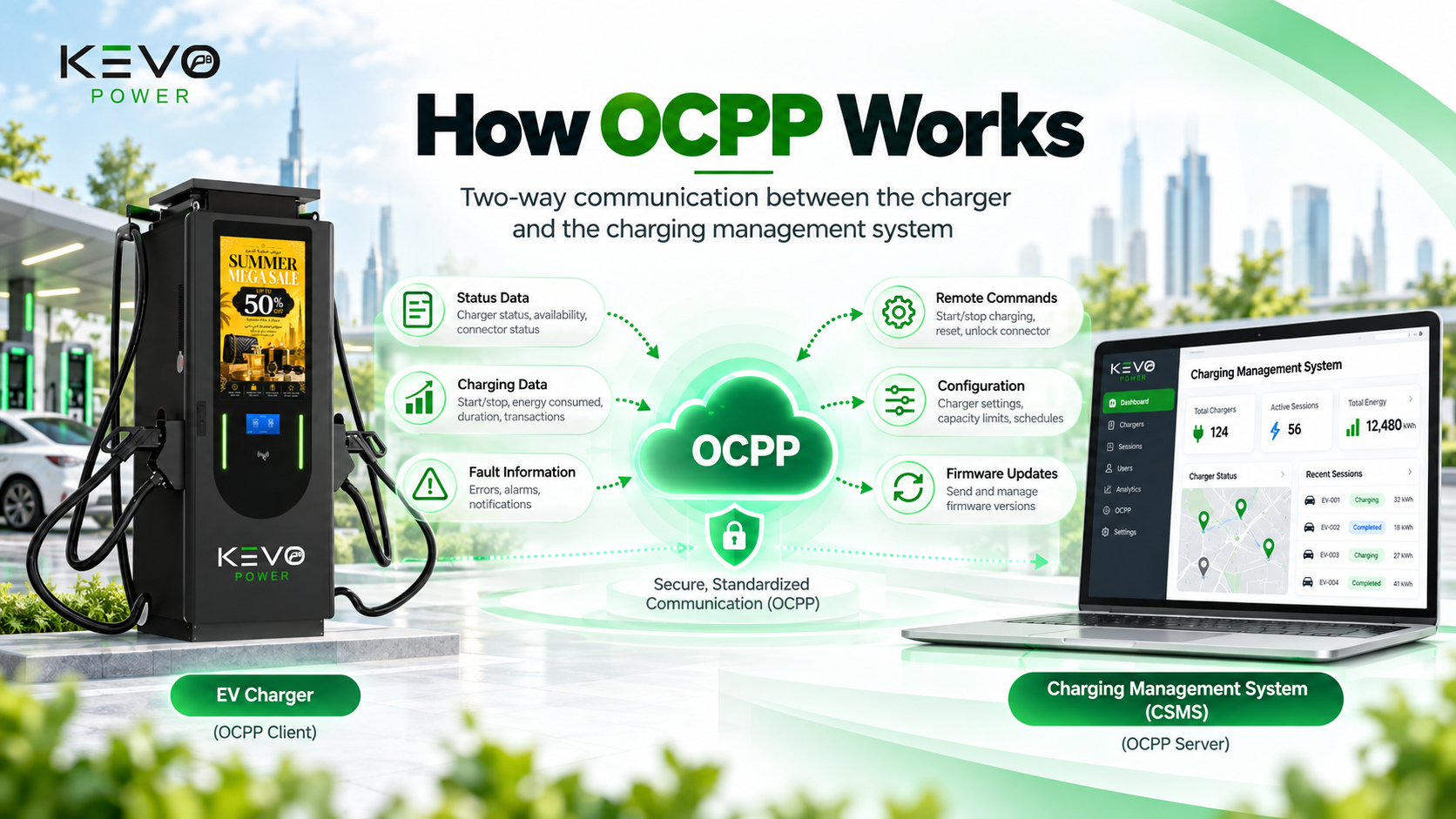
A simplified charging session might look like this:
- The charger connects to the backend and reports its identity and operational status.
- A driver presents an RFID credential or uses an app; the charging system checks whether the session is authorized.
- Charging begins, and the charger sends transaction and meter information as configured.
- The backend can monitor the session and, where implemented, issue supported remote commands.
- When the session ends, the backend records the transaction information for reporting and related services.
Actual behavior depends on the OCPP version, the supported features, and the charging network configuration. OCPP does not itself provide the cellular connection or process bank-card payments.
Main Functions of an OCPP Charging Station
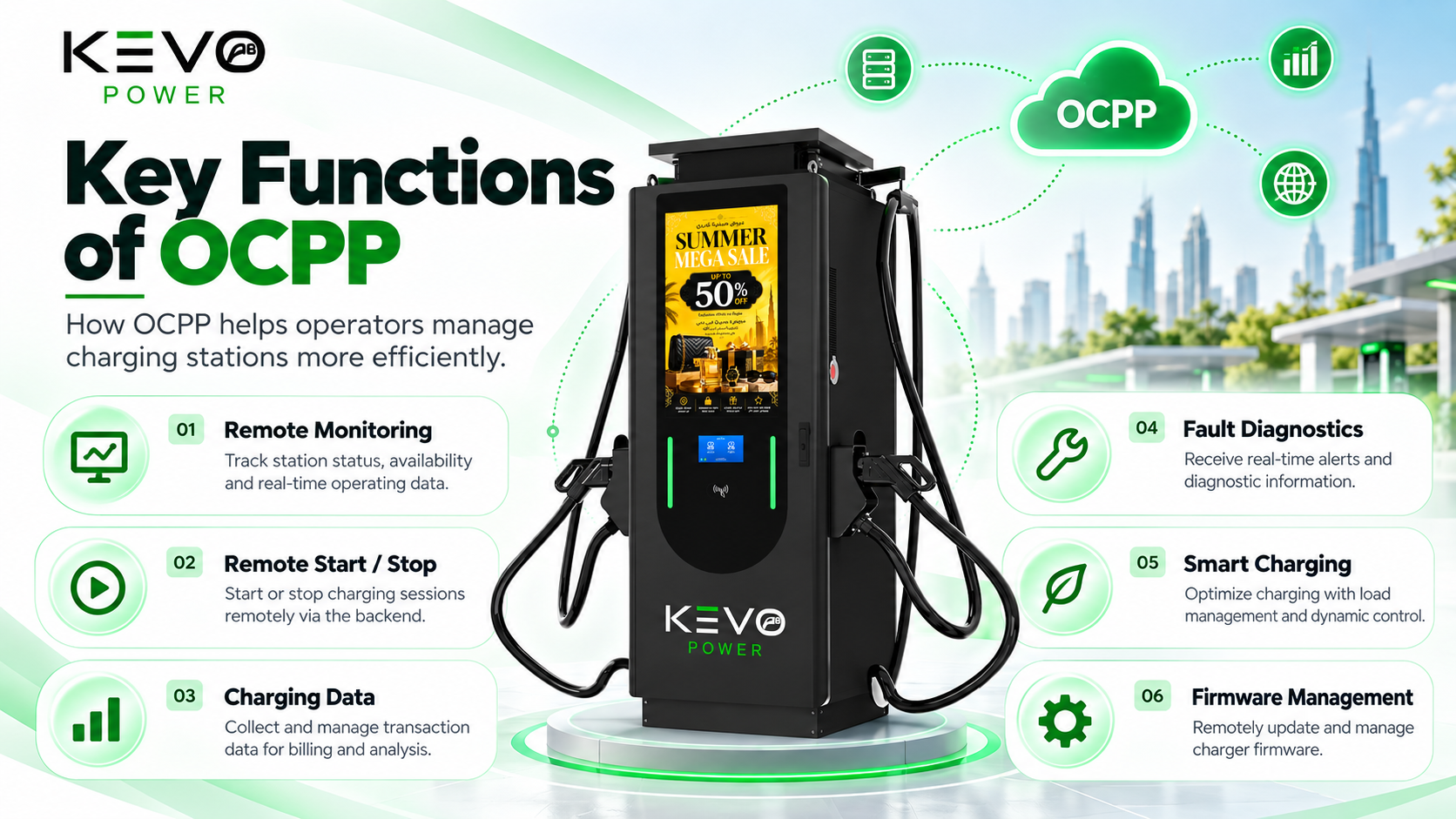
Remote Monitoring and Charger Status
Operators can monitor whether a charging point is available, occupied, unavailable, or experiencing a problem. For companies managing chargers across multiple sites, centralized visibility can reduce the need for routine on-site checks.
Remote Start and Stop
Supported implementations allow the backend to request remote charging actions. This can help support teams assist drivers and manage operations without physically visiting every charger. Remote commands remain subject to authorization, charger state, and safety logic.
Charging Sessions and Energy Data
OCPP supports transaction reporting and meter-related information. Charging management software can use these records for monitoring, customer reporting, billing workflows, and operating analysis. Actual billing and payment services are delivered by the surrounding business systems.
Diagnostics, Maintenance, and Firmware
Depending on the version and feature support, a CSMS may retrieve diagnostic information, receive error notifications, adjust configuration, or coordinate firmware updates. Better visibility helps technicians prioritize investigations, but it does not replace hardware maintenance.
Smart Charging and Power Management
OCPP can support charging profiles and controlled power delivery, helping operators coordinate energy use across multiple chargers. Advanced implementations may integrate site-level electrical limits, demand-management rules, or energy-management software. The capabilities must be checked against the selected chargers and backend.
Integration Across Charging Networks
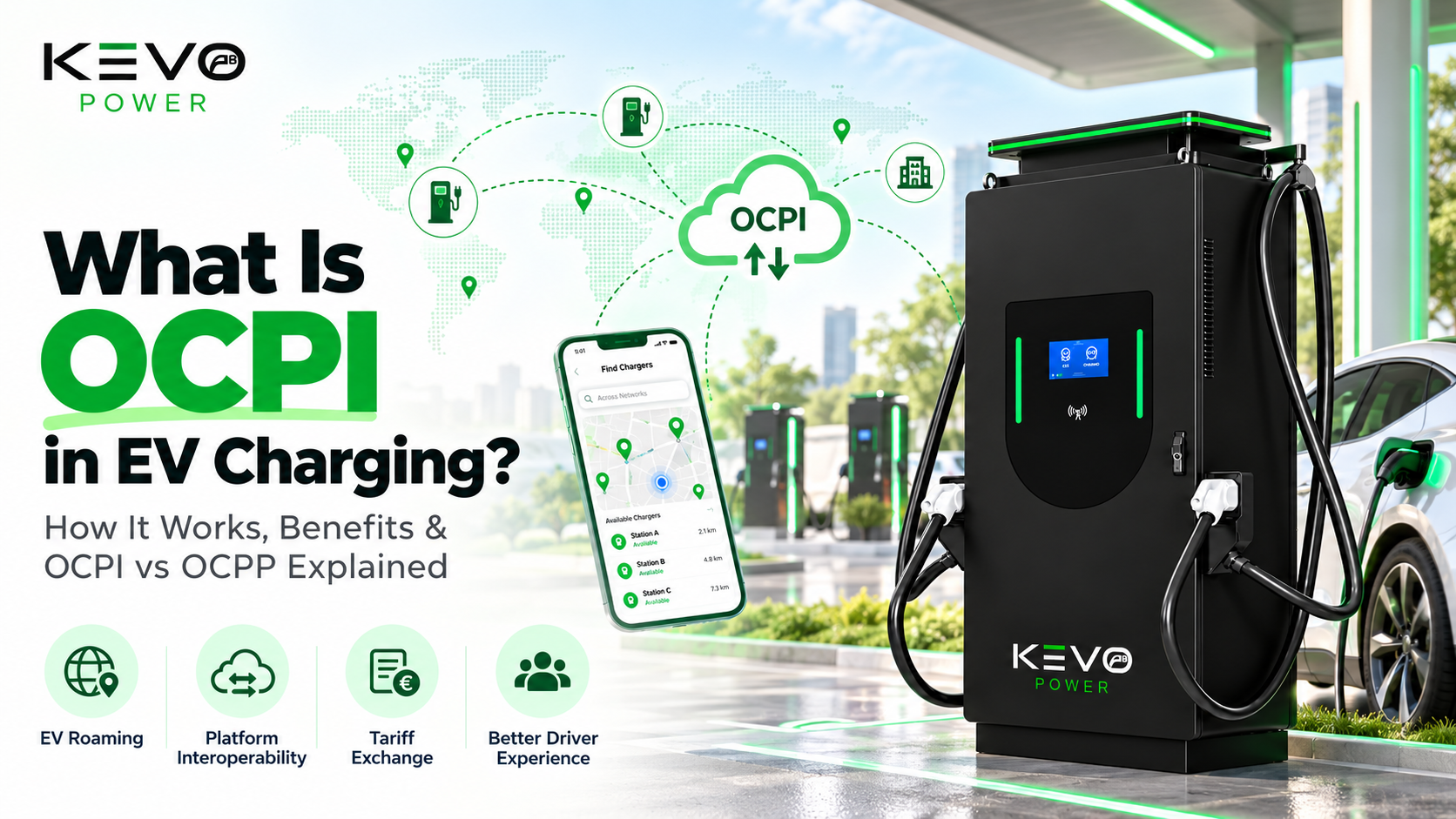
Using an open protocol can make it easier to build a network with hardware and software from different vendors. It can also improve flexibility when an operator later considers another CSMS. However, migration still requires data planning, configuration work, and interoperability verification.
OCPP 1.6 vs OCPP 2.0.1 vs OCPP 2.1
The three OCA-supported versions serve different project needs. The right choice depends on the software ecosystem, security requirements, charging functions, and integration roadmap—not simply on choosing the highest version number.
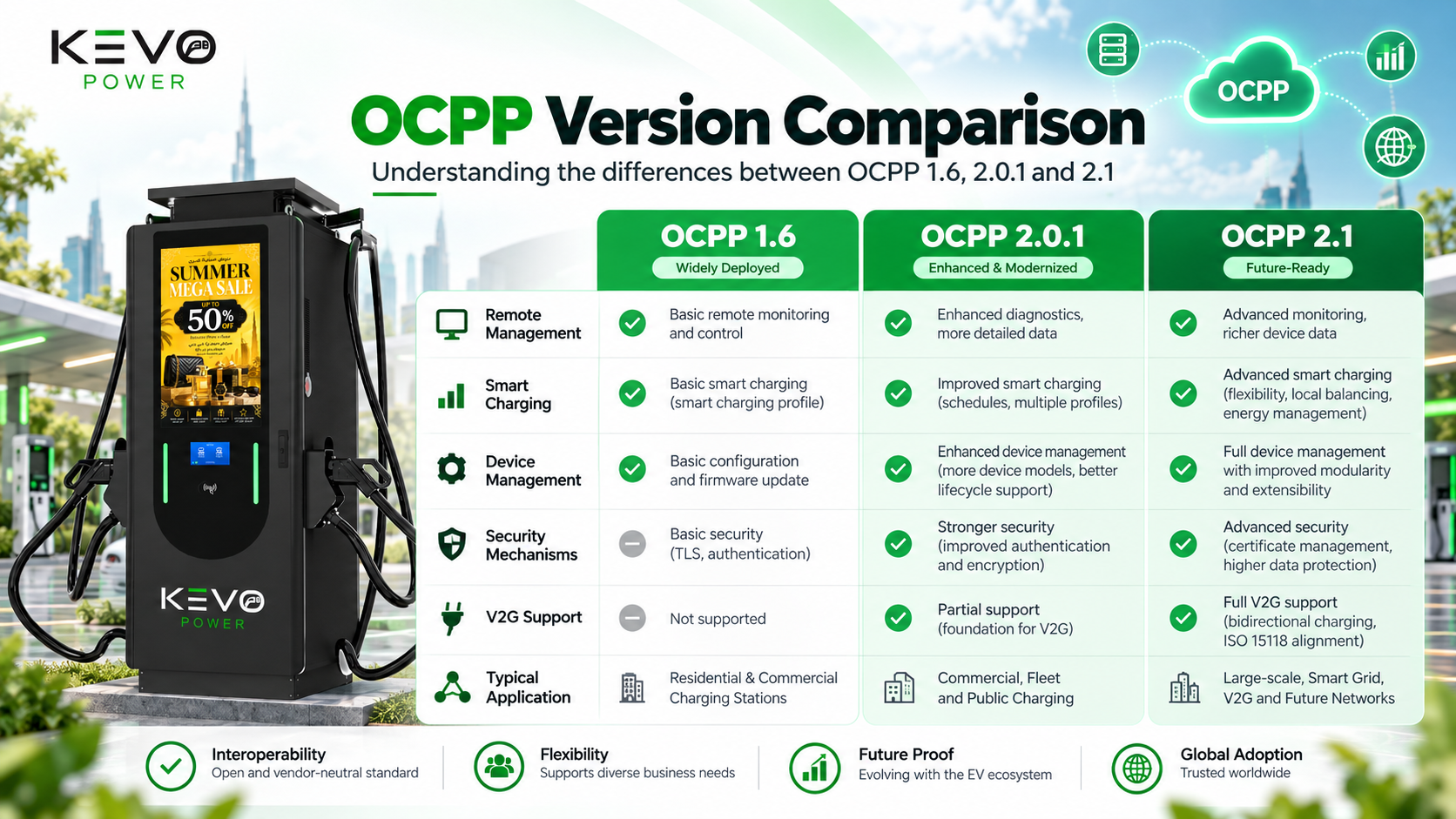
OCPP 1.6 is still common in deployed charging networks and supports core operations and smart charging. OCPP 2.0.1 introduces an advanced device model, improved transactions, stronger security capabilities, and ISO 15118-related support. OCPP 2.1 builds on 2.0.1 and adds functionality related to bidirectional energy transfer, distributed energy resource control, battery swapping, and additional transaction and payment scenarios.
Important: OCPP 1.6 and OCPP 2.0.1 are not backward compatible. OCPP 2.1 was designed to preserve 2.0.1 application logic. Support for a protocol version does not automatically mean that every optional feature is implemented or available in a product.
Why OCPP Matters to Commercial Charging Operators
Less Dependence on a Single Supplier
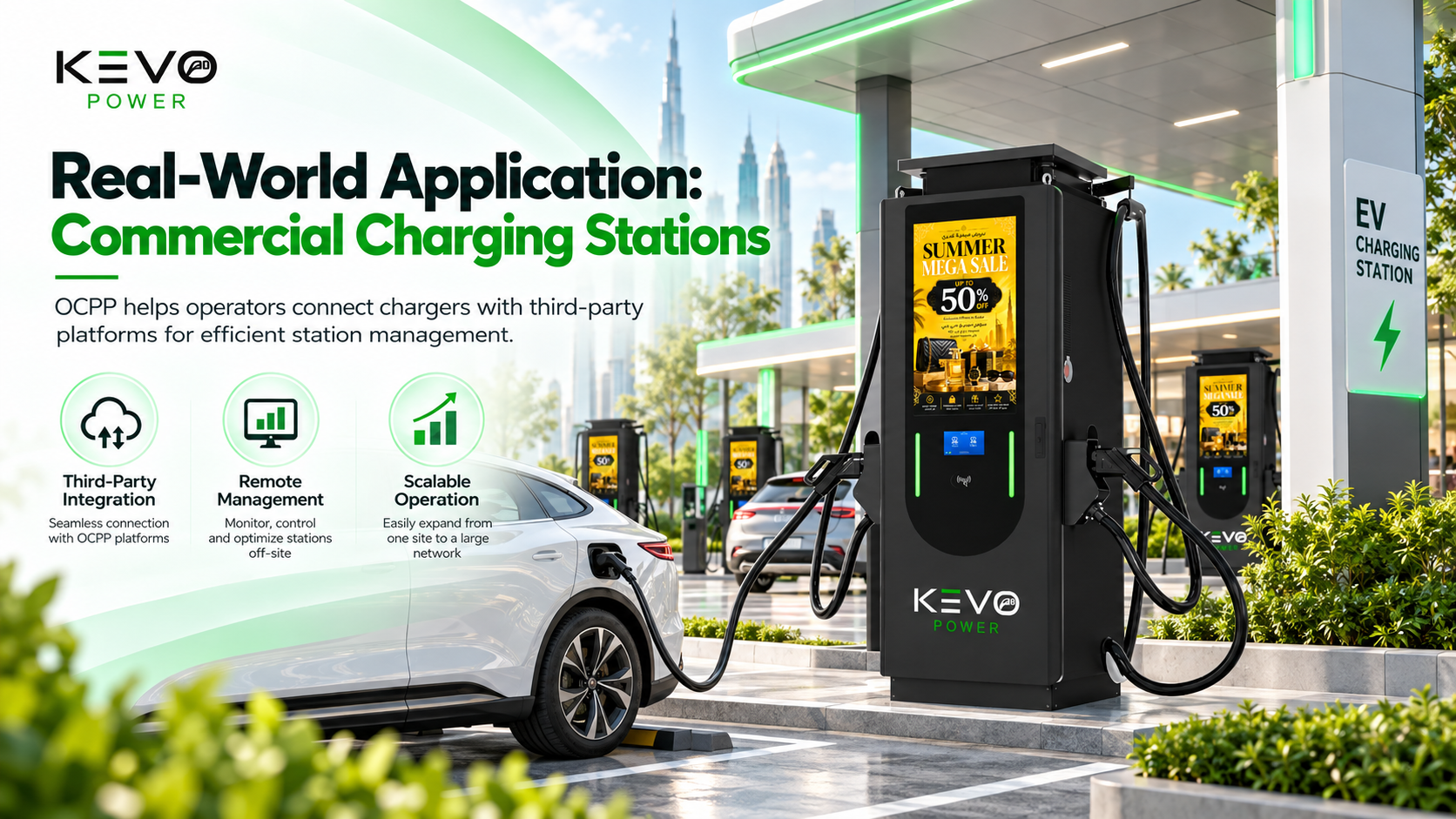
With a well-planned open-protocol deployment, operators can evaluate multiple charger or backend providers rather than automatically remaining with a proprietary combination. This helps preserve procurement flexibility as the business grows.
More Efficient Multi-Site Operations
A centralized CSMS can help operators view charger statuses, review sessions, and respond to issues across multiple destinations. For public parking, fleets, retail locations, and service areas, consistent monitoring becomes more valuable as the charger count increases.
A More Scalable Technology Roadmap
Networks evolve. Operators may introduce higher-power DC chargers, new payment methods, energy-management functions, or more charging locations. Selecting appropriately tested OCPP implementations can make future integration projects more manageable, although no single protocol guarantees effortless upgrades.
How to Choose an OCPP EV Charger
Before purchasing charging equipment, ask the supplier and your CSMS provider to confirm the following:
- Which exact OCPP version and transport are supported (for example, OCPP 1.6J or 2.0.1)?
- Which needed functions are implemented and enabled: RFID authorization, remote control, diagnostics, smart charging, or firmware updates?
- Has the charger been tested with the intended third-party CSMS and its security configuration?
- Does the implementation support the site’s communication connection, certificates, and operational reliability requirements?
- Is there verifiable OCA certification for the relevant charger software or product, if formal certification is a project requirement?
- Who will manage integration testing, backend credentials, firmware maintenance, and technical support after installation?
Note the distinction between “OCPP-compatible” and “OCPP-certified.” Compatibility is a supplier capability statement; certification requires the applicable formal OCA testing and approval process. Buyers should verify exact certification scope rather than assuming it from marketing language.
Does OCPP Work With AC and DC Chargers
Yes. OCPP concerns communication between a charge point and a management system, so it can be relevant to both AC and DC charging equipment. The physical connector standard—such as CCS2, GB/T, or another regional interface—addresses different requirements. A charger can support a particular vehicle connector and an OCPP backend simultaneously because they apply to different sides of the charging system.
For a business installing AC wallboxes at a workplace or DC fast chargers at a public station, OCPP requirements should be considered alongside power rating, local electrical regulations, safety features, connectivity, serviceability, and backend compatibility. For higher-throughput commercial sites, buyers can also review the KEVO Power DC Series VI configurations described below.
Frequently Asked Questions About OCPP EV Charging
Is OCPP free to use?
The OCPP specification is publicly available from the Open Charge Alliance. However, implementing the protocol, testing integration, operating a CSMS, or obtaining certification may involve development or commercial costs.
Can an OCPP charger connect to any management platform?
Not automatically. The charger and platform need a mutually supported version and functional configuration. Security setup, feature coverage, and interoperability testing are essential before launch.
Does OCPP provide a payment gateway?
No. OCPP exchanges operational and transaction-related information between the charging station and CSMS. Payment collection typically relies on additional software and payment-service integrations. OCPP 2.1 expands standardized support for some payment-related scenarios, but this is not a substitute for a complete payment service.
Is OCPP the same as CCS2 or ISO 15118?
No. OCPP governs charger-to-backend communication. CCS2 refers to a charging connector/system for the vehicle interface, while ISO 15118 concerns vehicle-to-charger communication, including capabilities such as Plug & Charge. These standards can work together within an EV charging solution.
Should every new project choose OCPP 2.1?
Not necessarily. A project using an established OCPP 1.6 or 2.0.1 backend may prioritize proven integration today. OCPP 2.1 deserves consideration where the required advanced functions are supported by both the equipment and software. Make the decision according to real system requirements.
Connect OCPP With KEVO Power DC Series VI
Choosing commercial EV charging hardware is about more than power output. Backend communication, installation requirements, maintainability, driver access, and integration support all affect the long-term operating experience.
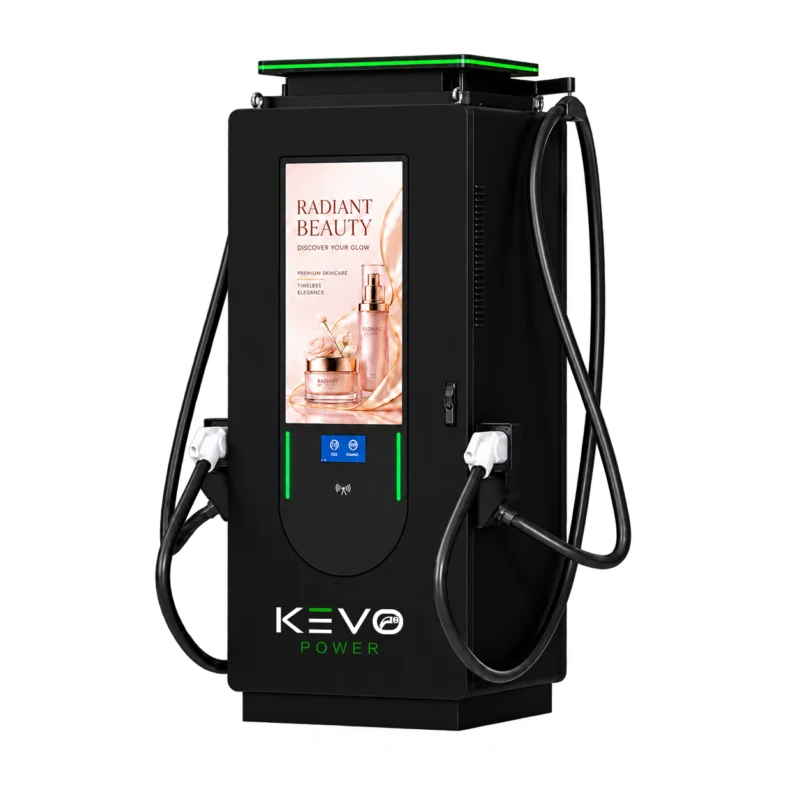
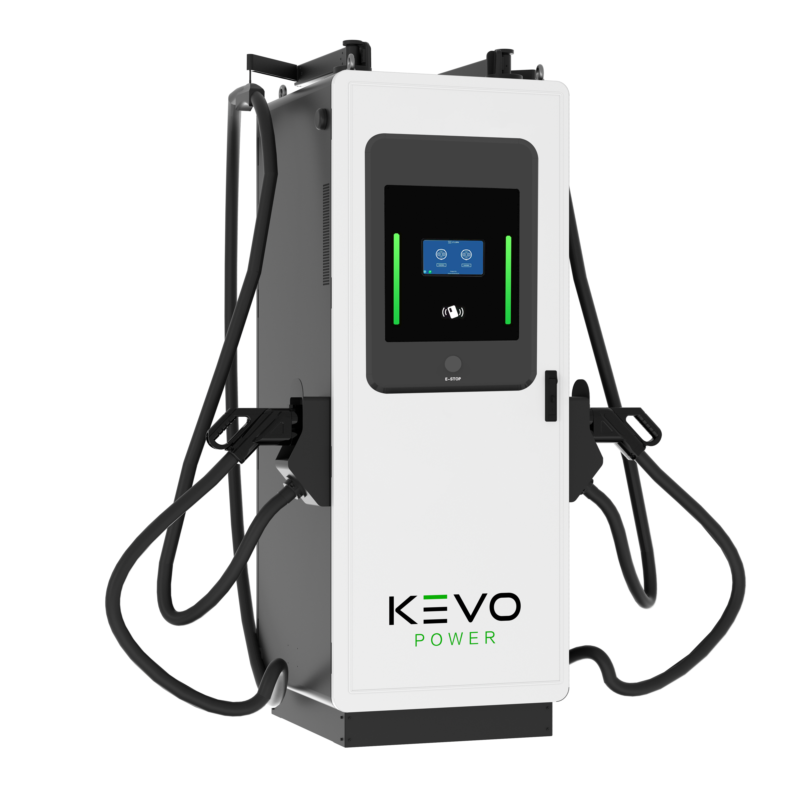
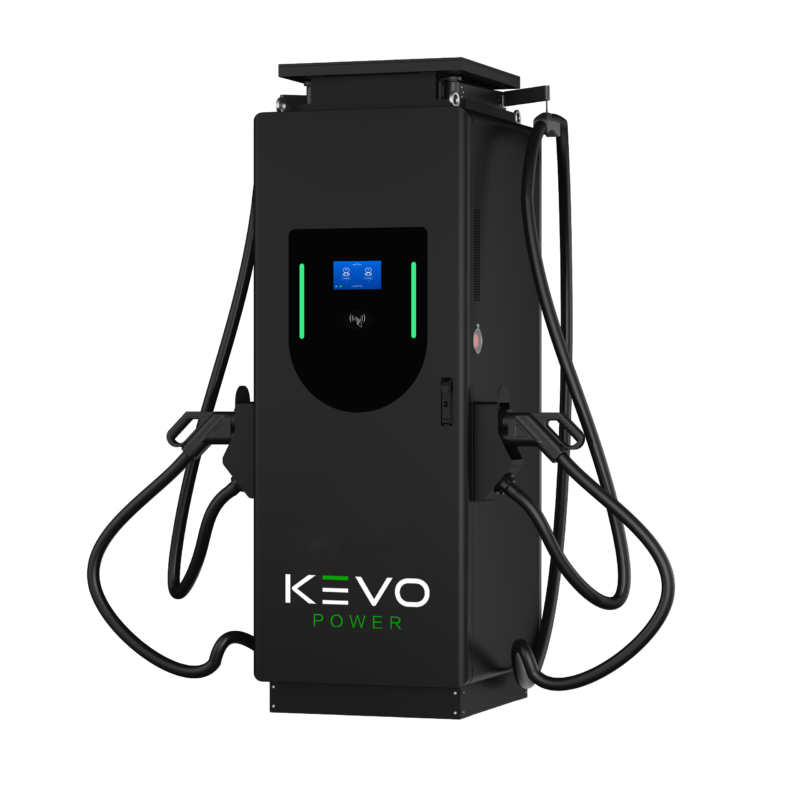
For commercial DC charging projects, KEVO Power DC Series VI is offered in 60 kW to 240 kW configurations. The current product page lists OCPP 1.6J and OCPP 2.0.1, 4G, Ethernet and Wi-Fi connectivity, a 32-inch advertising screen, IP54 protection, and POS payment support. Confirm the required protocol version, CSMS compatibility, security profile, payment workflow, and enabled functions for the selected model and software release before procurement.
Product connection: KEVO Power DC Series VI 60–240 kW DC fast charger
Project inquiry: contact KEVO Power or email info@kevopower.com
Technical References
- Open Charge Alliance — OCPP protocols
- Open Charge Alliance — OCPP FAQ
- Open Charge Alliance — What is new in OCPP 2.0.1
- Open Charge Alliance — OCPP 2.1 release
- KEVO Power — DC Series VI product page
Product note: OCPP availability, optional functions, payment support, connector configuration, and third-party CSMS interoperability should be confirmed for the selected charger model and software release.